Success Story

Quality Choice Landscaping: from a Wix page they didn't love to a business that outgrew mowing
Austin had a Wix site he didn't love, no business email, and leads that turned into phone tag. That was January 2023. Since then the site has been rebuilt twice, the business has outgrown mowing, and we are still working together. This is the story of a client who grew up with me.

Quality Choice Landscaping
Introduction
Client

Austin Avampato
Owner
Industry
Landscaping & Hardscaping
Murrysville, PA
Relationship
Since 2023
3 projects · ongoing
Live site
qualitychoicelandscaping.comWhat I did
Stack
The arc
Working together since 2023
- 2023Website
The website was the smallest problem
Austin had a Wix page he did not love and no business email, no scheduling, and a domain that was not his own name. The infrastructure came first, then the site.
- 2025Project
The channel worked; they did not need it
Meta ads to push the new design+build side. The numbers landed inside benchmark, but organic was already filling the schedule, so we stopped running them.
- 2025 — presentWebsite
Off Elementor, onto the current stack
Their WordPress became a headless CMS and the front end became Astro, so the next thing Austin asks for takes ten minutes instead of an hour of fighting a page builder.
At a glance
-
Built their first real website, then rebuilt it years later when my tools got better.
-
Set up their entire business infrastructure alongside the site: Google Workspace, Calendly, consolidated domains, proper email.
-
Migrated them off Wix, moved their domains to Namecheap, aligned their branding around the right domain.
-
Ran a paid ads campaign during their 2025 spring season. Honest numbers and honest lessons below.
-
Refactored the site from Elementor to a headless Astro frontend with the same WordPress backend, so their team did not have to relearn anything.
-
Still partners today. Next cycle is queued up: hiring acquisition, lead intake coverage, and more design+build campaign work.
Videos from this engagement
The raw 3.5-hour refactor session
Unfiltered, uncut. I recorded the entire Elementor to Astro refactor and published it.
Follow-up: what changed, what I learned
A shorter follow-up covering what shipped after the raw session.
The short version
Austin runs Quality Choice Landscaping out of Murrysville, PA. We started working together in early 2023. Since then I have rebuilt his website twice, set up most of his business infrastructure, run paid ads during his busy season, and watched his company evolve from mostly mowing and maintenance into a real design+build operation.
This is not a project case study. It is a relationship case study. Most of what is valuable here happened between the headlines.
How it started
January 10, 2023. Austin sent me a message: “What’s up bro, would you be interested in helping me out with our website?”
We knew each other from ball hockey. He had a landscaping company, a handful of years in, a Wix website he did not love, and the honest admission that he was not technical. He described himself that way. He built what he could on Wix, it worked, it was enough to exist online, but it was not enough to grow.
That was the opening of a three-year conversation.
Act 1: the first build, and everything that came with it
When I started digging in, it was clear the website was the smallest problem.
They did not have business email. No Google Workspace. Email signatures did not exist. They had no scheduling tool. When a lead came in, Austin was playing phone tag to book a consult.
The domain situation was also off. Their website lived on qcscape.com, a shortened version of the brand name. They did not own qualitychoicelandscaping.com. I advised them to lock in the full-name domain so the public URL actually matched what the business was called. We purchased it, moved the site there, and kept qcscape.com alive for email so nothing in their existing pipeline broke.
So before I wrote a single line of site copy, we cleaned up the foundation:
- Set up Google Workspace so they had real business email and a real Drive.
- Built out proper email signatures for the team.
- Stood up Calendly for consultation scheduling. This one alone changed how they booked work.
- Consolidated every domain under Namecheap. No more hunting for logins across five providers. No more GoDaddy upsells in their inbox.
- Acquired
qualitychoicelandscaping.comand made it the public face of the brand. Keptqcscape.comas the email domain for continuity.
Then we built the website. I used WordPress with Elementor, which was the right tool at the time. The new site had everything the old one did not: all their services, team bios, an FAQ, job listings, an employment application, Calendly embedded directly for scheduling, real imagery. A full upgrade from the Wix page they were replacing.
It shipped in the summer of 2023. They stopped paying Wix. They paid me a monthly care plan fee instead, which covered the site plus everything else I was managing for them. One invoice, one point of contact, everything handled.
Act 2: the ads campaign
Austin asked about Facebook ads. Spring 2025, start of their busy season. The business was trying to lean harder into design+build work, higher ticket projects like patios, walkways, and outdoor living spaces, not just mowing and maintenance.
Here is the deal. I am extremely capable of running Meta ads, which is what we ran here. It is not my absolute specialty, but it is something I can do well, and I am always up to trying to get results for my clients. So when Austin asked me about it, the answer was straightforward. Yes, we could test this channel, and that is the right way to figure out whether it works. We had the relationship and the trust to run the experiment.
Looking back, the real constraint was not the channel. It was timing. Austin wanted to use ads to grow the hardscaping and design+build side of the business, but that side was brand new. There was not much of a process behind it yet. Not many finished projects. Very few real photos. No established offer to point at.
They wanted to advertise outdoor kitchens and patios. They had not built many. So they had very few real photos to use. We leaned on AI-generated imagery for some of the creative, which in early 2025 was still rough. That was the constraint going in. I tell you this because the numbers below only make sense with that context.
The spring 2025 residential campaign, April 5 through June 1:
- $1,702 spent
- 78,036 impressions
- 26,612 reach, 3.82 frequency
- 1,425 total clicks, 775 link clicks
- CPC: $1.18 all clicks, $2.17 link clicks
- CTR: 1.81% all clicks, 0.98% link clicks
- CPM: $21.37
- 676 landing page views, $2.49 cost per view
- 19 on-site schedules
- Cost per scheduled consult: $88.68
Against home services Meta benchmarks, this was a reasonable campaign. CPC and CTR sat in the normal band. Cost per raw lead on Meta for home services typically runs $40 to $80, and we delivered $88 per booked on-site consult, which is a higher-intent action than a form fill. Apples to apples, the equivalent form-lead cost was comfortably inside the benchmark.
It was an okay campaign. It generated real leads and a handful of booked jobs. It was not a home run.
The reason we pulled it is not that it failed. It is that QCL did not actually need it. Their organic lead flow was already strong enough to keep the team busy through the spring. Every intake call, we would ask where they found us, and the answer was almost always Google. We will come back to that in a minute, because it turned into one of the more interesting patterns of this engagement.
Act 3: the refactor
Late 2025 into early 2026, Austin came to me with a specific ask: they wanted to lean harder into design+build. They needed a real presence for it on the site. A dedicated page with the right flow, the right imagery, the right forms.
And I had been dreading doing another Elementor edit for about a year.
In the time since I built the first QCL site, my own stack had evolved. WordPress with Elementor became WordPress with Bricks, which became AI-coded frontends in Astro, which became the current setup I use on most new builds. Every time Austin asked for a change, I was going back into Elementor and fighting the page builder for an hour to do something that, in my current workflow, would take ten minutes.
The math was obvious. If I wanted to actually help them faster on the next phase, I had to get the site off Elementor. So I did.
I kept their WordPress backend intact and cloned it to cms.qualitychoicelandscaping.com as a headless CMS. The content, the job listings, the team bios, the services data, all of it stayed in place. Nothing for their team to relearn.
The public-facing site became a new Astro frontend, static, fast, hosted on Cloudflare Pages, rebuilding automatically when their team edits content in WordPress. Better performance. Lower DOM weight. Cleaner structure. And crucially, a foundation I could extend quickly when they asked for something new.
I filmed the whole thing. The two videos above are the raw session and a follow-up. No cuts, no polished b-roll, no talking head. Just me doing the work, on camera, for three and a half hours, because that is what this actually looks like.
Right after the refactor landed, we built the design+build page Austin had come in asking for. The thing that triggered the whole rebuild.
Where it goes from here
This is the part of a case study where most agencies would write a cleaner-than-life closing paragraph. This is not that. We are in the middle of this story, not at the end of it.
QCL has transitioned from a mowing-heavy operation to a business trying to do more higher-margin design+build work. That requires different marketing, different systems, and different internal infrastructure than mowing does. Which means there is real work queued up, not hypothetical work.
The most recent proposal I put in front of Austin was a three-part systems bundle, pitched to run once they were through the seasonal rush:
- Hiring acquisition. A real careers flow: better job pages, proper hiring ads, a real application intake. Their team has been growing and the current process is informal.
- Lead intake coverage. Making sure no call gets missed. Voice agent coverage, call recording, structured handoff into their CRM. Especially important in the busy season when they are in the field.
- Customer acquisition. A dedicated design+build landing page (shipped) with proper ad campaigns behind it. Real creative this time, because they now have real projects to show.
None of that is committed yet. It is a conversation. Which is how most of our work has started over the last three years, so I expect some of it will happen.
Why this one matters
Austin is one of the longest-running clients I have. His business has grown up. My own stack has evolved through three generations of tooling. Every time I got better at what I do, he benefited, because the thing I built him got better too.
That is the real pitch of a care plan. It is not site maintenance. It is a relationship where the work compounds.
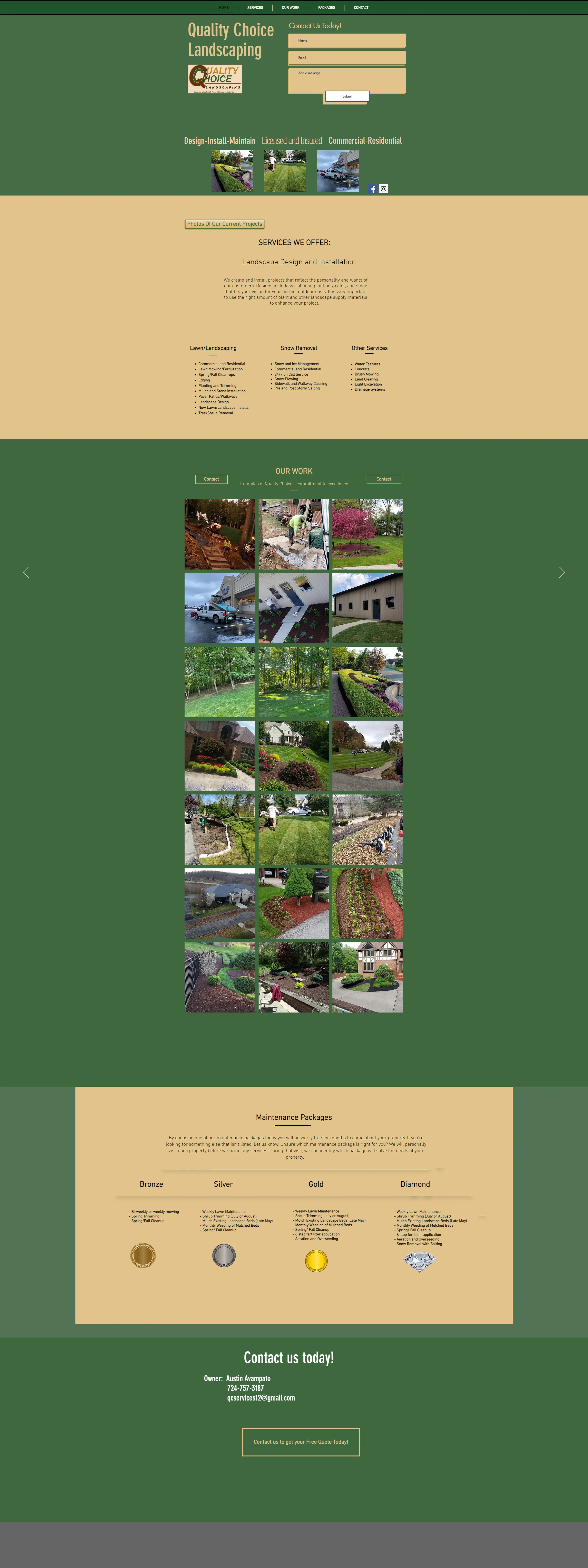
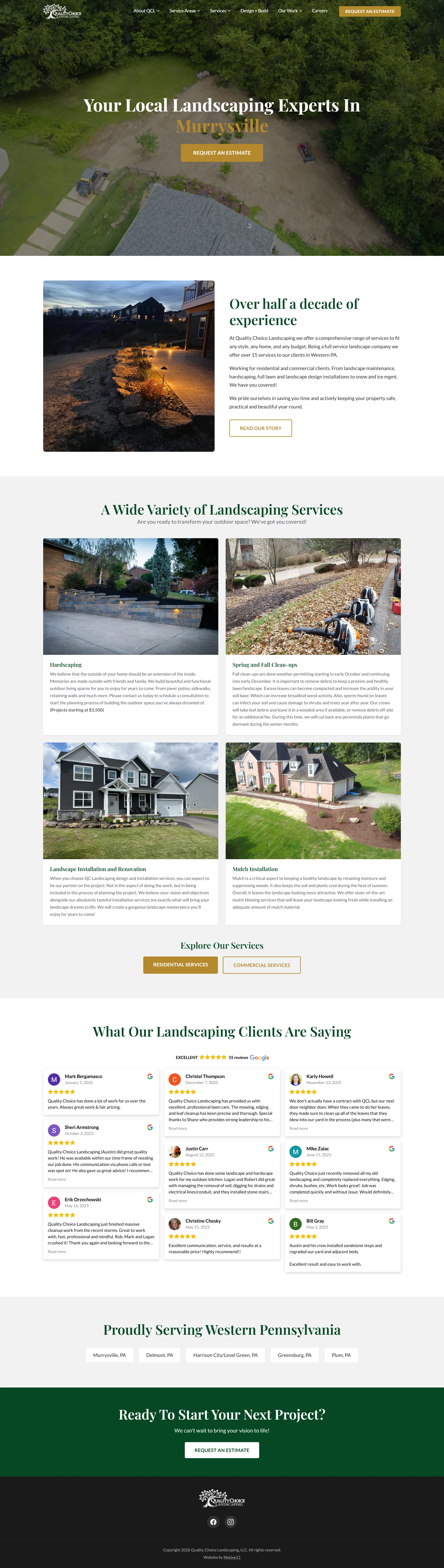
Before & after
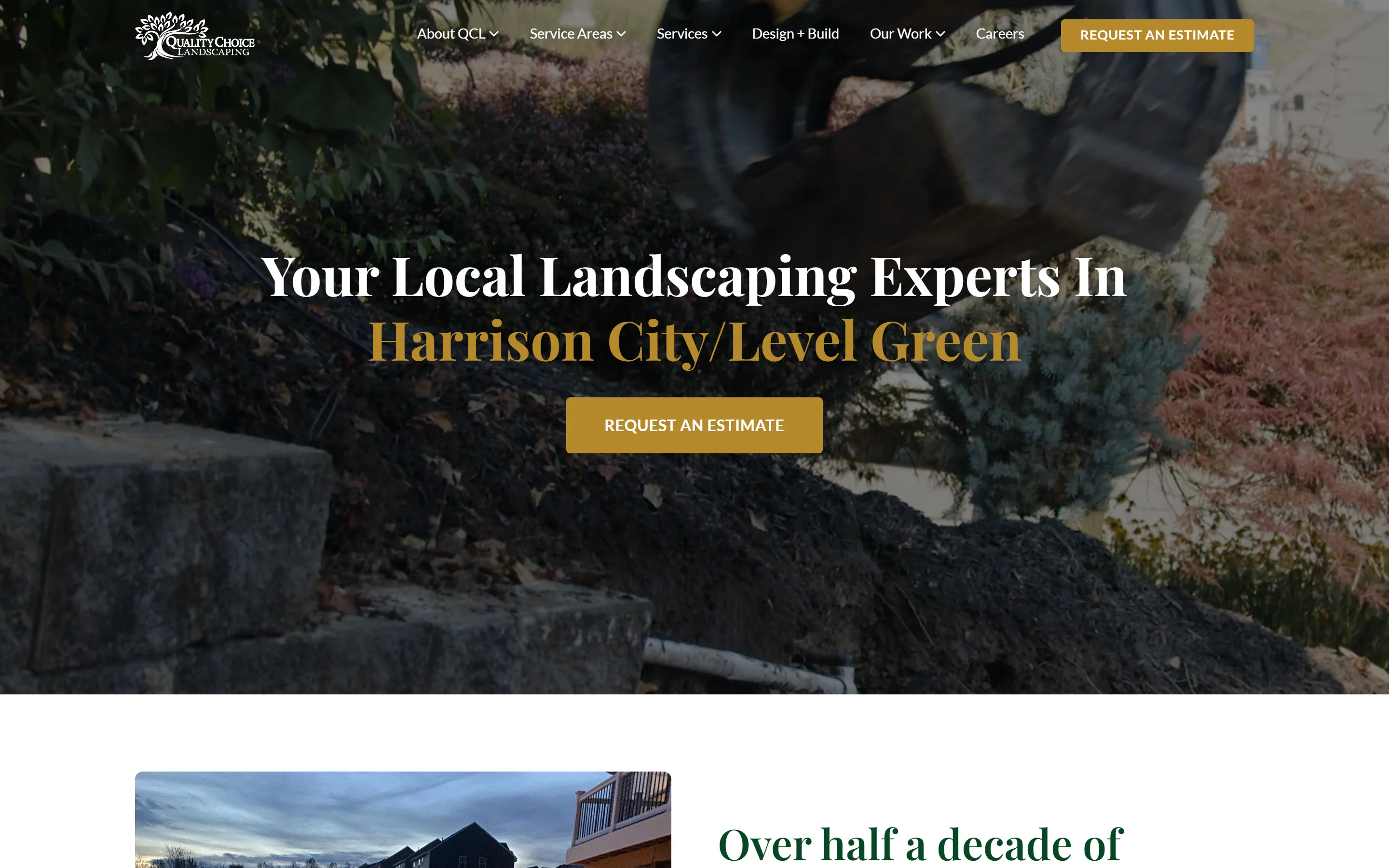
Full homepage
I hit Mark up a few years ago because I needed a better website and I did not really know where to start. I am not a tech guy. What I got was somebody who actually figured out what I needed before I did. He rebuilt the site, got us on real email through Google Workspace, set us up on Calendly, and cleaned up the domain mess I had going on across a couple of different places. That stuff alone made my business feel more put together overnight. Since then he has just kept helping. When we started moving more into hardscaping and design+build work, he rebuilt the site again so we could add landing pages and campaigns faster. He has thrown good ideas at me for years, some we have done, some are still on the list. If you are a small business owner looking for someone who actually thinks about your business and not just the thing you hired him for, talk to Mark.
Want a story like this?
I take on a limited number of builds per quarter. If you're a small business owner who knows something is off and isn't sure how to name it, start here.
Work with meMore success stories
Pindrop
Pindrop: he built the platform, I told him what he couldn't see
Three weeks old, signing people up faster than anyone could watch, and custom domains, the thing his customers needed to go live, would not work. He is not a developer and he built all of it himself. I came in from outside, fixed it in a day, and then spent a session on where the product actually goes.
Sheffler & Company
Sheffler & Company: from a Wix page to running their proposals
Before they could price a job, somebody had to dig through county and state websites, and every proposal was put together by hand in Word. A 50-year-old engineering and surveying firm hired me for a website. Two years later their leads, their site research, and their proposals have a home in software I built for them.